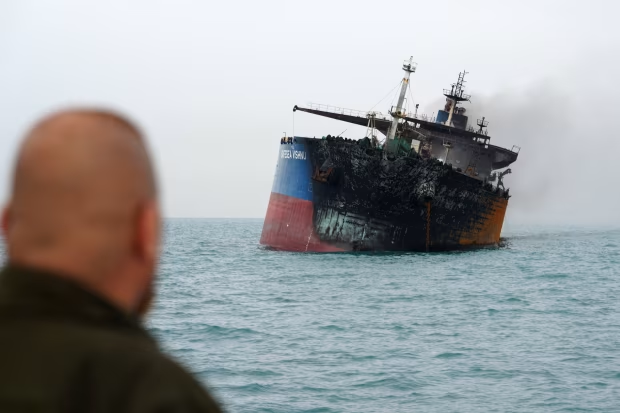
Initial Signal
The closure was the tail end of a pattern, not the start of one.
The mainstream framing of the Hormuz closure treated it as a discrete geopolitical event — a decision made in Tehran in response to a specific provocation, priced into markets within a single trading session. That framing is analytically lazy. It collapses a twelve-month escalation chain into a single news cycle, and in doing so makes the event look unpredictable in retrospect. It was not unpredictable. It was overdetermined.
The signal chain that produced the closure was composed of readable indicators from four distinct streams: IRGC Navy exercise tempo, insurance market repricing, shadow fleet composition shifts, and Iranian domestic political positioning. None of these individually would have been sufficient. Stacked, their joint probability distribution pointed at a closure or near-closure scenario with a confidence that consensus analysts declined to price, because pricing it required committing to a forecast that was politically uncomfortable.
IRGC Navy exercise frequency in the Gulf increased in tempo and shifted in character — from show-of-force patterns to anti-shipping and mine-laying profiles. The profile change was the signal, not the frequency.
War risk insurance premiums for Gulf transits repriced in two discrete steps. Underwriters saw what spot oil markets did not.
Shadow fleet composition shifted toward vessels flagged in jurisdictions with limited enforcement exposure. Risk was being laundered through flag-of-convenience optionality.
Iranian domestic rhetoric shifted from "deterrence posture" to "sovereign right of response" framing. The vocabulary is load-bearing. It always is.
Back-channel negotiations that had been stabilizing in Q4 2025 decayed into unilateral messaging by early 2026. When the back channel goes quiet, the front channel stops mattering.
Any one of these streams in isolation would have been dismissible. The joint signal — four independent observation channels all rotating in the same direction over a compressed window — was not dismissible, and was not dismissed by anyone whose job required them to be correct. Insurance underwriters priced it. Hedge fund energy desks positioned for it. The mainstream press reported each stream as a separate story and never integrated them, because integration requires an analytical frame and the mainstream frame for the Middle East is event-by-event, not system-level.
This is the gap SOD was built for.
Actors Identified
Incentives, not intentions. Always.
Reading the chain required modeling each actor by their revealed incentive structure rather than their stated position. Stated positions in the Middle East are almost always diplomatic theater. Revealed incentives — what actors actually gain from specific outcomes — are the only reliable input.
| Actor | Revealed Incentive | Constraint |
|---|---|---|
| IRGC | Demonstrate escalation dominance without triggering a decapitation response. Closure is the ceiling of coercive utility before U.S. direct intervention becomes inevitable. | Internal Iranian factional competition; Supreme Leader succession dynamics. |
| Saudi / UAE | Public alignment with Gulf security framework; private diversification of export routes and hedging via pipeline and Red Sea capacity. | Cannot visibly profit from a Hormuz crisis; must perform solidarity. |
| China (PBOC / Sinopec) | Secure discounted Iranian crude under sanctions pressure while positioning yuan-denominated energy settlement as a contingency rail. | Avoid direct confrontation with U.S. secondary sanctions architecture. |
| U.S. Fifth Fleet | Maintain freedom-of-navigation posture without committing to a sustained kinetic campaign ahead of election-adjacent political calendar. | Force posture insufficient for prolonged convoy operations; budget cycle friction. |
| Global Insurers | Price tail risk ahead of market consensus. Lloyd's syndicates and reinsurers revise war-risk zones before political consensus acknowledges the threat. | Capital adequacy requirements force earlier signal recognition than equity markets. |
| Hedge Fund Energy Desks | Asymmetric long-volatility positioning in Brent and tanker equities. Quiet accumulation, loud denial. | Position-size disclosure lag means the footprint lags the thesis by weeks. |
The single most useful observation from this actor map: the parties with financial capital-adequacy requirements (insurers, reinsurers) repriced before the parties with political capital at stake (governments, central banks) acknowledged the repricing was warranted. This is structural, not incidental. Underwriters are paid to be early. Politicians are paid to be late. Markets that require regulatory capital against specific exposures are leading indicators for markets that do not. This is a replicable pattern and one of the core SOD observation rules.
The parties who have to post capital against being wrong always see the signal first. Everyone else is watching them and calling it their own insight.
Second-Order Implications
The closure is not the story. The transmission chain is.
The first-order effect of the closure is visible to anyone with a chart — oil above $105/bbl, Brent volatility at multi-year highs, headline CPI to 3.26%. The first-order effect is not the analytical product. The second-order effects are, because they are where capital is being misallocated by actors who believe they have already priced the event.
The Fed loses its cutting option.
Energy-driven headline inflation cannot be met with rate cuts without breaking the inflation-expectations anchor rebuilt between 2023 and 2025. The "simultaneous hold" posture across DM central banks is not a policy choice — it is the residue of constraints imposed by the closure. Any market participant pricing cuts into H2 2026 is pricing a scenario that requires Hormuz to reopen and oil to retrace below $85. Both, not either.
The EM refinancing wall is now a cliff.
USD-denominated frontier sovereign debt (Ethiopia, Ghana, Zambia, Pakistan) is unrefinanceable at higher-for-longer DM rates when export receipts for commodity-exporting borrowers compress and energy-import costs balloon for non-exporters. The contagion graph runs through the IMF, whose fiscal capacity to anchor fifteen-plus simultaneous distress cases is not credible at current programmatic scale.
The petrodollar recycling loop stalls.
Gulf surplus recycling into Treasuries and DM bank deposits assumes oil flows and returns-on-capital behave in historical patterns. A prolonged closure plus sovereign-wealth exposure freezes meaningful portions of the recycling mechanism. Nobody has modeled what the U.S. Treasury funding curve looks like if that flow stalls for two quarters. The answer is not in anyone's base case because it has never been in anyone's base case.
China acquires a yuan-settlement template.
Discounted Iranian crude sold in yuan during a closure window is not a commercial event. It is the stress-test of an alternative settlement architecture that previously existed only as a theoretical contingency. Once the template runs once at scale, it exists as operational capability for every future sanctions regime. The closure did not create yuan-energy settlement. It made it real.
The July 2026 tariff cliff becomes binding.
USMCA mandatory review and expiring U.S. trade exemptions land in July 2026 against a stagflationary backdrop imposed by the closure. A renewal failure is no longer absorbable — it becomes a second-wave supply-chain shock layered on an energy shock, with a thinned bank capital buffer and a Fed that cannot cut. Three months away. Not being priced.
What Others Missed
The consensus read was not wrong at the event level. It was wrong at the system level.
The insurance repricing as leading indicator.
War-risk premium curves for Gulf transits repriced in two discrete steps before the closure occurred. This data was public. It was reported in trade press and ignored by macro desks because the audience for Lloyd's market commentary does not overlap with the audience for oil-price commentary. The signal was in the seam between two professional communities that do not read each other's primary sources.
The vocabulary shift in Iranian state messaging.
The move from "deterrence" to "sovereign right of response" in Iranian domestic rhetoric was a first-order signal for anyone with even shallow Persian-language monitoring. Western analysts covering the Middle East predominantly read translated feeds, which smooth these shifts into generic adversarial language. Translation is compression. Compression loses the signal.
The shadow fleet as a leading indicator.
Flag-of-convenience composition shifts in the Gulf-adjacent tanker fleet were legible through MarineTraffic and ship-registry data. Shipping analysts noted them. Macro desks did not cross-reference them against war-risk pricing because shipping data is treated as a commodity-specific input rather than a geopolitical indicator. Cross-domain integration is the product, not the data.
The petrodollar recycling vulnerability.
Every major analyst house published Hormuz-closure scenarios. None of them carried the scenario through to Treasury funding implications, because doing so would have required modeling a regime change in U.S. deficit finance that is politically uncomfortable and professionally unrewarding to publish. The most consequential implication was the one the consensus was least incentivized to state out loud.
The timing correlation with U.S. domestic political calendar.
The closure window was bounded on one side by IRGC operational readiness and on the other by U.S. political attention bandwidth. Actors with coercive leverage over U.S. interests tend to escalate during windows when the U.S. response function is domestically constrained. Timing is a revealed signal of adversary confidence in the response function's degradation. It is not paranoia to notice this. It is analysis.
The signal is almost never hidden. It is distributed across professional communities that do not read each other. Integration is the product.
Related layer
See the Geo-Signal Fusion layer
This case study shows the method in retrospect. The project page shows where that signal-integration layer sits inside the broader SOD workflow.
Go to Geo-Signal Fusion