Source 01
Open-Source Intelligence
Public reporting, monitoring feeds, official releases, regional incident trackers, and fragmented first indicators that something is shifting before the consensus catches up.
Second Order Dynamics | Narrative Formation Framework
How Second Order Dynamics identifies weak signals, maps actors, tests competing explanations, and forms narratives that clarify what is happening beneath the visible event.
Structured Analytic Discipline
Analysis of Competing Hypotheses extends the logic of the scientific method into intelligence environments where controlled experiments are rarely possible.
The scientific method begins with observation, forms testable hypotheses, evaluates evidence, and revises conclusions as new information emerges. ACH follows the same discipline, but applies it to uncertain, incomplete, and often adversarial information environments.
The distinction matters. In science, a hypothesis gains strength by surviving attempts at falsification. In intelligence analysis, an assessment gains strength by surviving structured disconfirmation. ACH operationalizes that principle by placing multiple hypotheses side by side and testing each one against the same body of evidence.
This prevents the analyst from building a case around a preferred explanation. Instead, the method asks which explanation has the fewest inconsistencies, which assumptions are doing the most work, and what future evidence would strengthen or overturn the judgment.
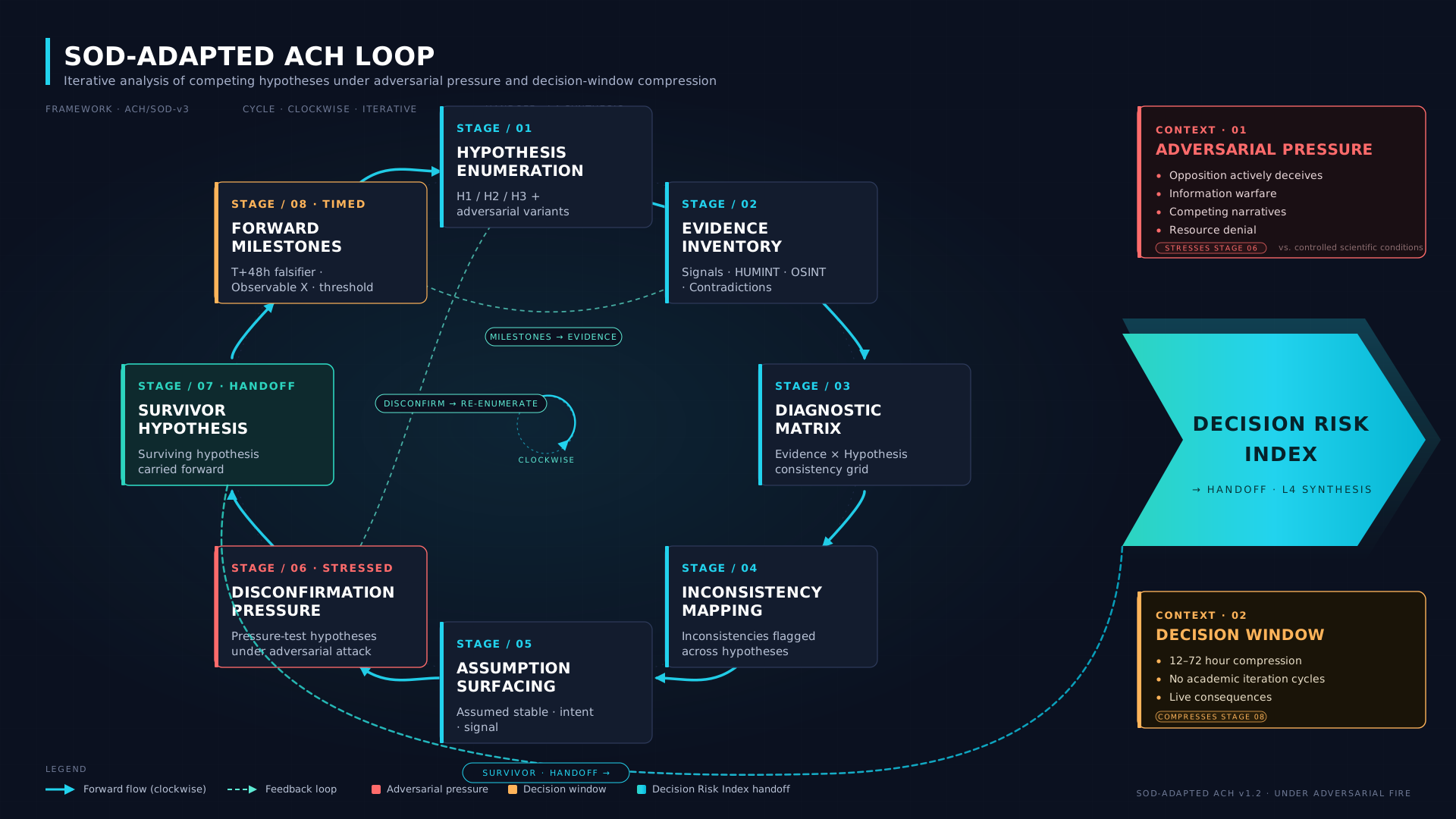
For Second Order Dynamics, this is where scientific reasoning and strategic intelligence converge. The goal is not to claim certainty. The goal is to reduce error, expose weak assumptions, and preserve decision advantage under uncertainty.
Phase 01 — Signal Detection
Most events are signal clutter. The task is to identify the signals that suggest deeper structural movement — where markets, institutions, technology, incentives, and human behavior begin to converge in ways that may produce outsized consequences.
Source Layer — Where the Signal Appears
Source 01
Public reporting, monitoring feeds, official releases, regional incident trackers, and fragmented first indicators that something is shifting before the consensus catches up.
Source 02
Dislocations, volatility spikes, liquidity stress, pricing anomalies, and policy reactions that reveal hidden pressure in the system.
Source 03
Shifts in rhetoric, crowd sentiment, elite signaling, group identity activation, and decision patterns that reveal where human behavior may become a force multiplier.
Source 04
Hearings, policy drafts, enforcement actions, leadership statements, procurement moves, and bureaucratic friction points that indicate internal adjustment.
Source 05
Force posture, diplomatic sequencing, alliance signaling, logistics strain, and regional power behavior that suggest an event is not isolated.
Source 06
Cyber indicators, infrastructure anomalies, data releases, platform manipulation, and emerging technologies that alter the shape of risk.
Evaluation Criteria
| Signal | What We're Looking For | Weight |
|---|---|---|
| Second-Order Potential | Does this have the potential to trigger meaningful downstream effects beyond the immediate event? | High |
| Cross-Domain Convergence | Are multiple systems aligning — political, economic, technological, behavioral, military, informational? | High |
| Hidden Mechanism | Is there evidence that the visible narrative is incomplete, misleading, or missing a key driver? | High |
| Timeliness | Is the signal emerging early enough to shape understanding before the narrative hardens? | Medium |
| Verifiability | Can the signal be supported through public evidence, corroboration, or pattern consistency? | Medium |
Applied Example
Signal: A policy announcement, unusual market behavior, and coordinated messaging from multiple institutions appear within a narrow time window.
Why it matters: The visible event may look administrative, but the convergence suggests stress inside the system. The narrative begins not with the headline, but with the pressure pattern underneath it.